欢迎来到 [蚂蚁街]
, 进入
2027宁波国际文具展
When young people would rather pay for a forest-bathing experience or a late-night anonymous conversation than drink another glass of social wine, it becomes clear that the underlying logic of consumption is quietly changing. This is no longer a question of “what to buy,” but of “why to buy.” Meaning-based consumption refers to purchasing decisions driven not only by material satisfaction, but also by emotional resonance, spiritual identification, and a sense of value. Emotion, identity, and meaning have become the key reasons new-generation consumers are willing to pay a premium.
The “Meaning Shopping Cart” of a New Generation
From Gen Z’s designer toy collections to wellness travel for seniors, from Citywalks to Moutai’s shift toward “self-pleasing consumption,” a transformation centered on meaning is reshaping the intersection of markets, policy, and culture.
Stress relief, companionship, healing—squeeze toys, collectible blind boxes, paid “emotional tree-hole” platforms, camping, frisbee, forest bathing, Citywalks, the calm “Capybara” IP, and the sharp-toothed little monster LABUBU… These emotionally supportive, nature-connected, and psychologically compensatory consumption trends have become the new traffic drivers among young consumers.
Consumption is shifting from function and ownership toward meaning and identity. In 2025, LABUBU set a record with an auction price of RMB 1.08 million, while its producer Pop Mart saw its share price rise nearly 200% at one point. With its “ugly-cute,” rebellious, and highly personalized image, LABUBU precisely captures Gen Z’s desire for self-expression and uniqueness, becoming a new form of social currency.

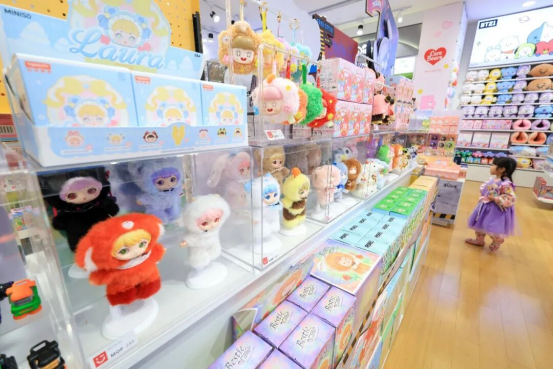
Young shoppers browse anime-themed merchandise at The Venetian Macao shopping mall. Photo by Mao Siqian
New-generation consumers are willing to pay a premium for cultural values, emotional experiences, and identity labels they recognize. What they purchase is not merely a product, but an answer to “Who am I?” and “What do I stand for?”
“Consuming for emotion, paying for meaning” is reshaping market structures and aligns with the national call to foster new forms of consumption. The future growth of consumption lies deeply embedded in shifts of meaning.
The Generational Restructuring of Consumption Logic
Once a symbol of status and social interaction, Moutai is now accelerating its shift toward self-oriented consumption because the relentless decline in both wine prices and share prices. He Yong, Secretary-General of the China Alcoholic Drinks Association, noted at the inaugural Chishui River Forum that the current consumer market is undergoing profound transformation, with alcoholic beverage consumption shifting from the traditional focus on "pleasing others" towards "indulging oneself".
Each generation articulates its value propositions through distinctive consumer language. For older generations, consumption was intrinsically linked to family building, social status and material accumulation; for the new generation, it increasingly manifests as a relentless pursuit of cultural identity, emotional resonance and personal definition. LABUBU has tapped into the pulse of the emotional economy, aligning precisely with the evolution of consumer drivers. Moutai's transformation towards youthfulness, health, and "self-indulgence" profoundly illustrates that even the most enduring "symbols of meaning" must actively adapt to new "signals of meaning".
The meaning economy is rising across society. This is not exclusive to the young, but a collective rebuilding of values and connections after material abundance has been achieved. People once favoured displaying social status through 'hard symbols' such as luxury goods, high-end vehicles, and properties in desirable school catchment areas. Today's consumption patterns are shifting towards quality living and aesthetic expression, while children's education is evolving from a focus on academic competitions to a broader enrichment of character, pursuing 'holistic education'.
The silver-haired generation is also an active participant, expanding consumption from healthcare and eldercare to wellness communities, senior universities, and “return-to-youth” experiences, redefining later stages of life with dignity, social connection, and quality.
As basic material needs are met, consumption climbs Maslow’s hierarchy toward higher dimensions. In an era of anxiety and pressure, a significant “meaning deficit” has emerged—along with new value chains and business opportunities.
A New Business Civilization under High-Quality Development
In the post-materialist era, consumption growth comes from understanding shifts in culture, emotion, and identity—each representing an entry point of meaning: national brands as cultural confidence, interest communities as belonging, and health, healing, and experiential consumption as self-care.
Guided by policy, China is systematically cultivating multiple trillion-yuan-scale consumption sectors and hundreds-of-billions-yuan-scale consumption hotspots to enhance the alignment of supply and demand and stimulate the potential of domestic demand. This is no longer a niche experiment but a major future business pathway.
High-quality development manifests in the consumer sphere through a leap in the supply system from providing "standardised products" to responding to "personalised demands". It calls for the establishment of a modern market ecosystem that encourages innovation, embraces diversity, and operates in a regulated and orderly manner, enabling personalised demands to be seamlessly transformed into endogenous drivers of economic growth. Policy direction should focus on nurturing this transformation mechanism, thereby laying a solid institutional foundation for high-quality development.
Consumption is a barometer of the spirit of the times. This quiet shift from products to meaning speaks not only to economic growth, but also to how modern society rediscover and anchor the human spirit. It presents immense opportunities, yet simultaneously demands that we approach the very notion of 'meaning' with greater prudence and depth.
Life is not linear, but a complex function. Paying for meaning is like writing new code into the algorithm of life. In 2026, let us leave visible traces of meaning in time.
Declaration: This article comes from the China Comment.If copyright issues are involved, please contact us to delete

 12
12